
When Intelligence Scales Faster Than Wisdom
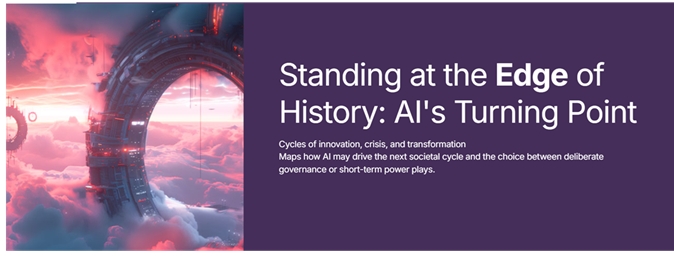
Imagine standing on the edge of history, observing a world shaped by forces that are often invisible until their consequences become unavoidable: technology, political power, economic pressure. Humanity has never moved in a straight line. Instead, it advances in cycles—periods of innovation and optimism followed by tension, crisis, and transformation. Artificial Intelligence marks the beginning of a new cycle, one that may redefine how societies function, govern, and even survive.
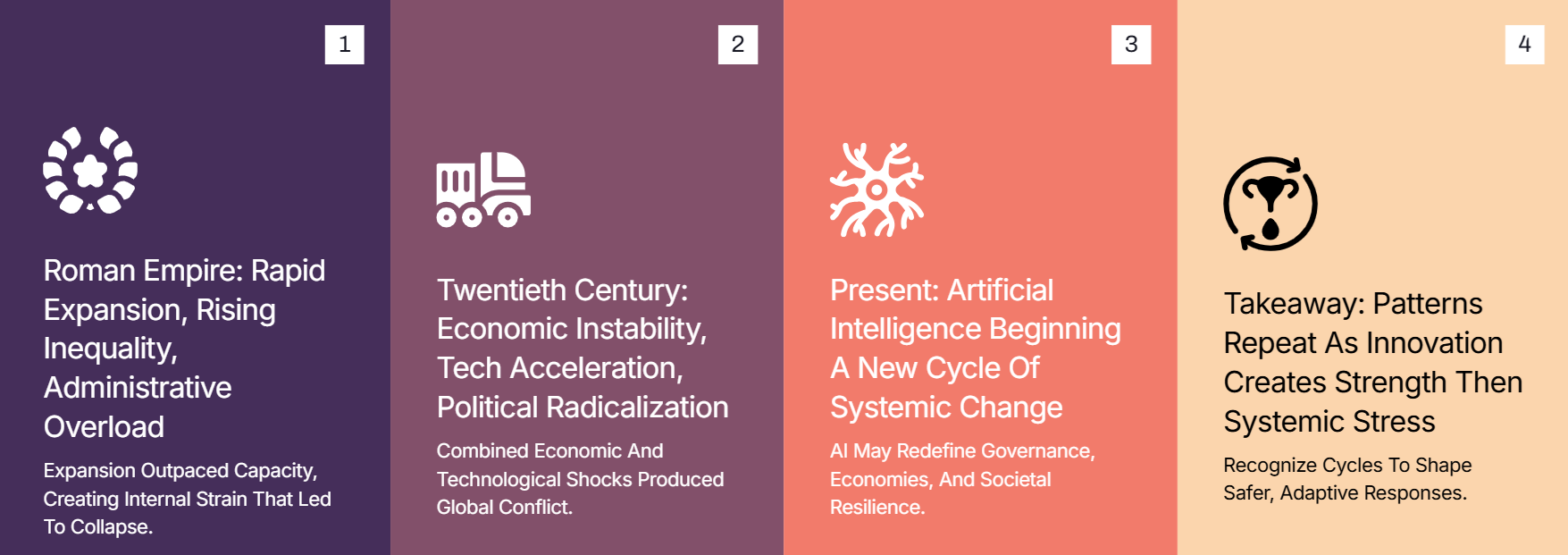
History rarely repeats itself exactly, but its patterns are strikingly familiar. Civilizations rise on the back of innovation and organization, accumulate power and wealth, and eventually face internal and external pressures they struggle to manage. The Roman Empire expanded faster than it could sustain, deepening inequality and administrative complexity until collapse became inevitable. The twentieth century’s world wars emerged from economic instability, technological acceleration, and political radicalization. Even pandemics have followed cyclical patterns, periodically forcing societies to reconsider how they organize health, labor, and governance.
These moments of disruption are rarely caused by a single factor. They emerge when technological progress outpaces social, political, and ethical frameworks. Today, Artificial Intelligence represents precisely that kind of acceleration. Unlike previous technologies, AI does not simply extend human labor—it replicates and amplifies decision-making itself. This makes it uniquely powerful and uniquely dangerous.
AI is not inherently good or evil. Its impact depends entirely on how it is designed, deployed, and governed. Used responsibly, it has the potential to revolutionize medicine, helping doctors diagnose diseases earlier and tailor treatments to individuals. It can improve energy efficiency, support climate research, expand access to education, and accelerate scientific discovery across fields that once progressed slowly. In this sense, AI could become one of humanity’s most valuable tools.
Yet the same capabilities can also deepen existing problems. Automation threatens to displace workers faster than societies can adapt. Surveillance technologies powered by AI risk eroding privacy and civil liberties. Autonomous systems introduce new ethical dilemmas in warfare and security. At an informational level, AI-generated content can distort reality itself, amplifying misinformation and undermining trust in institutions. The danger does not come from AI alone, but from deploying it without foresight, restraint, or accountability.
History suggests that when technologies reach this level of influence, cooperation becomes essential. Nuclear weapons forced rival nations to negotiate limits not because trust existed, but because the alternative was unacceptable. Global health coordination emerged after repeated failures to contain pandemics individually. AI presents a similar challenge: its consequences do not respect borders, yet governance remains largely national and fragmented.
Meaningful cooperation will not come easily. Nations compete for economic and strategic advantage, companies race to dominate markets, and legal systems differ widely. Still, shared risks have a way of reshaping priorities. Uncontrolled AI in military, financial, or cyber systems could destabilize entire regions. Markets benefit from predictable rules. Citizens increasingly demand transparency and ethical limits. Even from a strategic perspective, cooperation may be the only way to avoid a chaotic and dangerous arms race.
The past offers more than warnings—it offers guidance. Societies that manage technological change successfully tend to place human oversight at the center of critical systems. They use crises as moments to reform rather than simply recover. They recognize that inequality and exclusion weaken resilience, while shared benefits strengthen it. Most importantly, they act before reaching irreversible tipping points, when options narrow and consequences harden.
The central question, then, is not whether AI will reshape the world. That outcome is already underway. The real question is whether humanity will shape AI deliberately, or allow short-term incentives and power struggles to dictate its trajectory.
We are approaching a decisive moment. AI could amplify the best of human potential—knowledge, creativity, cooperation—or magnify the worst tendencies of history: concentration of power, conflict, and loss of agency. The next decade may determine whether governance remains reactive and fragmented, or whether shared principles and oversight emerge in time.
History shows that cycles can end in collapse, but they can also lead to renewal. The difference lies in awareness and choice. AI does not have to become a threat. Its greatest danger lies in human inaction, complacency, or refusal to learn from the past. The lessons are already written. What remains uncertain is whether we will apply them—or repeat the cycle once again.